
BINDSOL delivered five functional 316L stainless steel prototypes of a complex engine component to Scania in 8 working days, printed, machined and measured in one workshop in Kortenberg, Belgium.
| Customer | Scania |
| Industry | Commercial vehicles |
| Part | Complex engine component, functional prototype |
| Quantity | 5 prototypes |
| Material | Stainless steel 316L |
| Process | Metal 3D printing (LPBF/SLM), CNC machining, CMM inspection |
| Lead time | 8 working days |
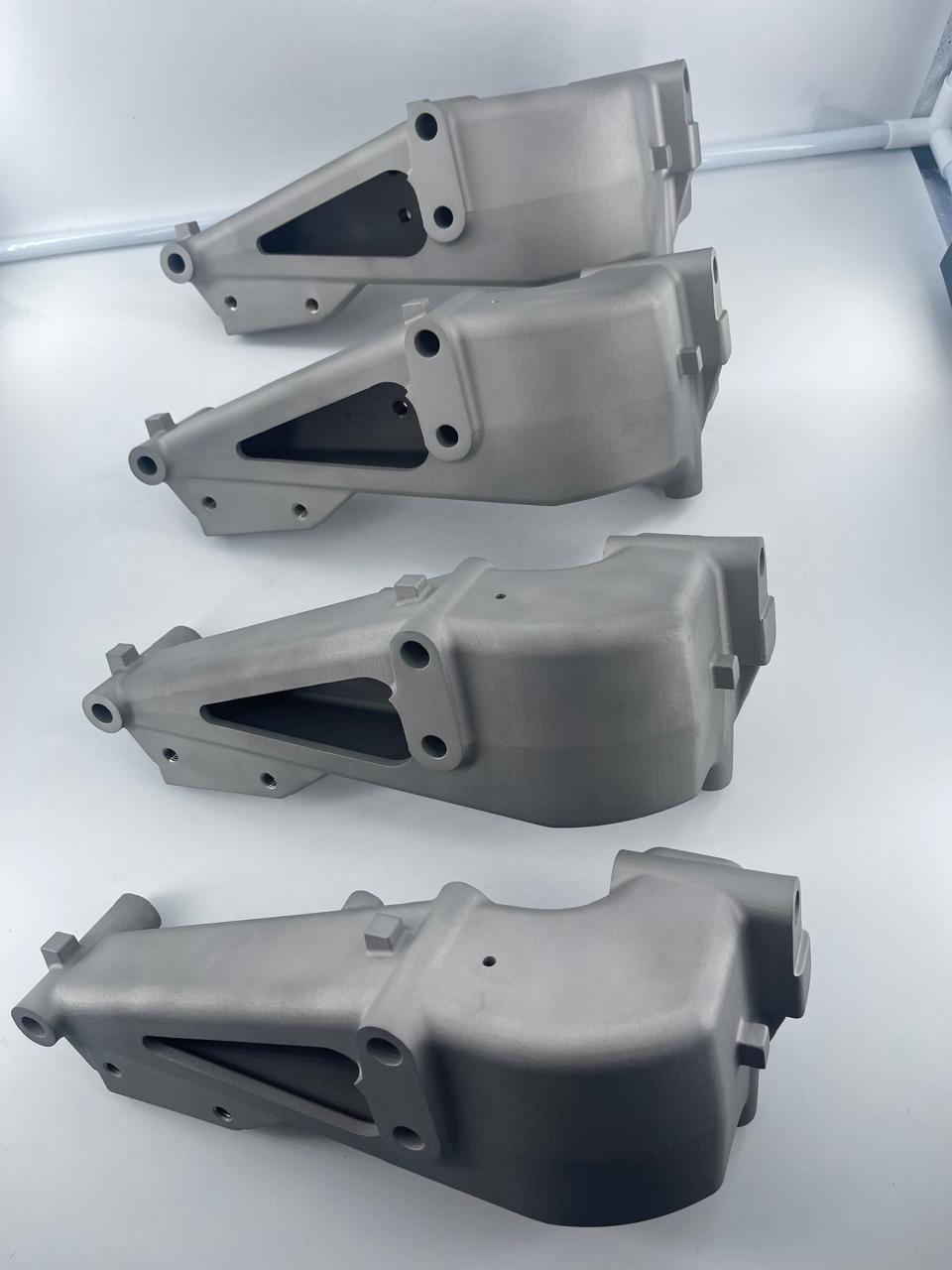
The challenge
Scania’s development team needed high-performance prototypes of a complex engine component, ready for functional testing within 8 working days. Conventional manufacturing routes could not meet that lead time without compromising dimensional precision and part quality.
BINDSOL’s approach
- Design for additive manufacturing (DfAM). The part was reviewed and prepared for printing, with machining allowance and datums planned before the build.
- Metal 3D printing. The prototypes were printed in 316L stainless steel by laser powder bed fusion.
- Post-processing. The printed parts were finished and prepared for machining.
- Precision CNC machining. Functional faces, bores and threads were machined to the drawing.
- Quality inspection. Critical dimensions were verified on a coordinate measuring machine (CMM) before shipment.
The result
- Five prototypes delivered in 8 working days, in time for the functional test.
- Full functional specification met on the printed and machined prototypes.
- A repeatable workflow that can be reused for the next design iteration.
- A stronger collaboration between the two engineering teams.
Why it worked
Printing, machining and inspection happen under one roof at BINDSOL. There is no hand-over between suppliers, so a printed part moves to the machine and then to the CMM without waiting time. That is what makes a printed and machined functional prototype in days, not weeks, possible.
Send us your CAD model and drawing to discuss a prototype with a short lead time.
